The Bookman’s Tale- a review

5 Comments

16158563The Bookmans’ Tale

by Charlie Lovett

published by Viking

2013

I received this book from Net Galley in exchange for an honest review.

Summary

Guaranteed to capture the hearts of everyone who truly loves books, The Bookman’s Tale is a former bookseller’s sparkling novel and a delightful exploration of one of literature’s most tantalizing mysteries with echoes of Shadow of the Wind and A.S. Byatt’s Possession.

Hay-on-Wye, 1995. Peter Byerly isn’t sure what drew him into this particular bookshop. Nine months earlier, the death of his beloved wife, Amanda, had left him shattered. The young antiquarian bookseller relocated from North Carolina to the English countryside, hoping to rediscover the joy he once took in collecting and restoring rare books. But upon opening an eighteenth-century study of Shakespeare forgeries, Peter is shocked when a portrait of Amanda tumbles out of its pages. Of course, it isn’t really her. The watercolor is clearly Victorian. Yet the resemblance is uncanny, and Peter becomes obsessed with learning the picture’s origins.

As he follows the trail back first to the Victorian era and then to Shakespeare’s time, Peter communes with Amanda’s spirit, learns the truth about his own past, and discovers a book that might definitively prove Shakespeare was, indeed, the author of all his plays.

My Review

“He was calm now-all sense of dread and panic banished by the simple act of losing himself in an old book.” 

This was my favorite line in this wonderful book by Charlie Lovett.  In The Bookman’s Tale, we meet Peter Byerly, a recently widowed antiquarian bookseller.  Peter struggles with the even the most simple social interactions, except when he was with Amanda, his dead wife.  Through flashbacks, we see how they met in college and fell in love.  Peter, now living in Kingham, England, is still struggling to overcome his grief and finally begins working again, when he stumbles on a book that pulls him into the mystery behind Shakespeare’s plays- namely whether Shakespeare really wrote them.  Peter attempts to discover whether this book, with marginalia that appears to be written by the bard himself, is a forgery or real. This pulls us in for another series of flashbacks, to 17th century England and again more in the 19th century.

I very much enjoyed this story.  It was extremely well written and certainly speaks to the heart of anyone who truly loves books.  Blogger Lauren Gilbart conducted a wonderful interview with the author at Books, Tea, and Me that really served as a wonderful tie-in to the book.  It was exciting having some insight into what helped create this wonderful book. Please go on over and read it at-http://booksteame.com

I would definitely recommend reading this book, especially if you are a book lover.  The only drawback I had while reading was my own fault.  I have always been a purist, and prefer to have my books in print form.  As I received this from Net Galley, I read it off of my daughter’s kindle, which I obviously have not mastered yet.  Because of this, I was at times confused by the various flashbacks, and couldn’t figure out how to flip back to organize names and dates.  Plus, I like reading about books with one in my hand!

Rating 4.5 out of 5

Orphan Train-She Reads May Book Club Selection

7 Comments

Orphan-Train-Cropped

Orphan Train

by Christina Baker Kline

published by HarperCollins

2013

Summary

The author of Bird in Hand and The Way Life Should Be delivers her most ambitious and powerful novel to date: a captivating story of two very different women who build an unexpected friendship: a 91-year-old woman with a hidden past as an orphan-train rider and the teenage girl whose own troubled adolescence leads her to seek answers to questions no one has ever thought to ask.

Nearly eighteen, Molly Ayer knows she has one last chance. Just months from “aging out” of the child welfare system, and close to being kicked out of her foster home, a community service position helping an elderly woman clean out her home is the only thing keeping her out of juvie and worse.

Vivian Daly has lived a quiet life on the coast of Maine. But in her attic, hidden in trunks, are vestiges of a turbulent past. As she helps Vivian sort through her possessions and memories, Molly discovers that she and Vivian aren’t as different as they seem to be. A young Irish immigrant orphaned in New York City, Vivian was put on a train to the Midwest with hundreds of other children whose destinies would be determined by luck and chance.

The closer Molly grows to Vivian, the more she discovers parallels to her own life. A Penobscot Indian, she, too, is an outsider being raised by strangers, and she, too, has unanswered questions about the past. As her emotional barriers begin to crumble, Molly discovers that she has the power to help Vivian find answers to mysteries that have haunted her for her entire life – answers that will ultimately free them both.

Rich in detail and epic in scope, Orphan Train is a powerful novel of upheaval and resilience, of second chances, of unexpected friendship, and of the secrets we carry that keep us from finding out who we are.  (from Goodreads)

My Review

I wasn’t sure what to expect from this book.  I love historical fiction, but this seemed like a strange premise. As I started reading, however, I realized that this was a part of history that I had not heard of before-the Orphan Trains.  I knew nothing about thousands of orphaned or destitute children from New York were shipped to the Midwest to be taken in and hopefully adopted by families.  This book seamlessly weaves together the story of Vivian and Molly. Molly is a 17 year old foster child who has been bounced around the system for years.  She is almost aged out, and is looking at a very uncertain future.  When a small misstep almost lands her in juvie, she accepts a community service sentence to help clean out 91 year old Vivian’s attic.  While working together, she learns Vivian’s story.  As a young girl, Vivian immigrated to the U.S. from Ireland in the late 1920’s.  When a fire claims the lives of her entire family, the Children’s Aid Society steps in and places Vivian along with other orphans onto trains bound for the Midwest.  There, they will hopefully find families that want to adopt them.  Unfortunately, more often than not, these families were looking for free labor.  The story alternated between Molly in the present day, and back flashes of Vivian’s experiences.

I really loved learning about the orphan trains and seeing history unfold through Niamh/Dorothy/Vivian’s eyes. I also learned quite a bit about the Penobscot Indians.  I thought this was a very well written, engaging story and would strongly recommend reading it.  I am so glad She Reads picked such a great selection for the May Book Club.  Please stop over there and see what others thought of this book.

http://www.shereads.org/2013/05/may-book-club-selection-4/

Rating 5 out of 5

“I love you,” he writes again and again. “I can’t bear to live without you. I’m counting the minutes until I see you.” The words he uses are the idioms of popular songs and poems in the newspaper. And mine to him are no less cliched. I puzzle over the onionskin, trying to spill my heart onto the page. But I can only come up with the same words, in the same order, and hope the depth of feeling beneath them gives them weight and substance. I love you. I miss you. Be careful. Be safe.”
― Christina Baker KlineOrphan Train

The Family Mansion

1 Comment

1617751669.01._SY160_SCLZZZZZZZ_

The Family Mansion

by Anthony C. Winkler

published by Akaschic Books

2013

I received this book through Library Thing’s Early Reviewer program in exchange for an honest review.

Summary

The Family Mansion tells the story of Hartley Fudges, whose personal destiny unfolds against the backdrop of nineteenth-century British culture, a time when English society was based upon the strictest subordination and stratification of the classes. Hartley’s decision to migrate to Jamaica at the age of twenty-three seems sensible at first: in the early 1800s Jamaica was far and away the richest and most opulent of all the crown colonies. But for all its fabulous wealth, Jamaica was a difficult and inhospitable place for an immigrant.

The complex saga of Hartley’s life is revealed in vivid scenes that depict the vicissitudes of ninteenth-century English and Jamaican societies. Aside from violent slave revolts, newcomers had to survive the nemesis of the white man in the tropics—namely, yellow fever. With Hartley’s point of view as its primary focus, the narrative transports readers to exotic lands, simultaneously exploring the brutality of England’s slavery-based colonization. (from Goodreads)

My Review

We first meet Hartley Fudges, the main character, in England, where he bemoans his bad luck at being the second (and non inheriting) son of a wealthy aristocrat.  Since he will not inherit anything from his father due to England’s primogeniture laws, his options for the future are limited-marry for wealth, join the clergy, or head to the colonies to make a living.  After some very bad choices, Hartley does head out – to work at a sugar plantation in Jamaica.  Once there, he immediately falls ill with Yellow Fever, which he barely survives.  After his recuperation, Hartley works as a backra, one of six white men who run the plantation under the manager.

Mr. Winkler has written an amusing, at times satirical novel, while touching on important historical aspects, such as human rights, slavery, and colonization.  There were times I felt it was almost too funny, but I never lost interest in the story.  I especially enjoyed the way the author described Hartley’s surroundings-

“London in 1805 was a crowded, dirty city exploding with industry and people.  The streets were jammed with horse-drawn carriages, and the pedestrians swarming everywhere had the pallor and bustling, scurrying energy of constant motion that might be found in a population of hungry marsupials.  Everywhere the eye looked it beheld smokestacks, grimy working men, sidewalk butchers, shrieking hankerers, and peddlers against a backdrop of persistent staccato hoof beats made by overworked horses harnessed to carriages, hackney cabs, and drays.”

I would recommend this book, especially to those who enjoy historical fiction.  I really enjoyed this book and look forward to reading more from this author.

Rating- 4 out of 5

Anthony C. Winkler was born in Kingston, Jamaica, in 1942 and is widely recognized as one of the island’s finest exports. His novels includeThe Lunatic (1987; adapted into a feature film), The Duppy (1997), Dog War (2007), and God Carlos (2012). He lives in Atlanta, Georgia.

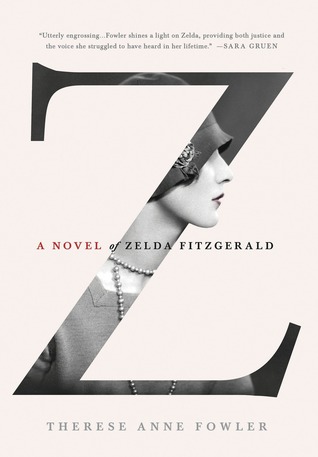
Z- A Novel of Zelda Fitzgerald

6 Comments

15994634

Z- A Novel of Zelda Fitzgerald

by Therese Anne Fowler

published by St. Martin’s Press

2013

Summary

When beautiful, reckless Southern belle Zelda Sayre meets F. Scott Fitzgerald at a country club dance in 1918, she is seventeen years old and he is a young army lieutenant stationed in Alabama. Before long, the “ungettable” Zelda has fallen for him despite his unsuitability: Scott isn’t wealthy or prominent or even a Southerner, and keeps insisting, absurdly, that his writing will bring him both fortune and fame. Her father is deeply unimpressed. But after Scott sells his first novel, This Side of Paradise, to Scribner’s, Zelda optimistically boards a train north, to marry him in the vestry of St. Patrick’s Cathedral and take the rest as it comes.

What comes, here at the dawn of the Jazz Age, is unimagined attention and success and celebrity that will make Scott and Zelda legends in their own time. Everyone wants to meet the dashing young author of the scandalous novel—and his witty, perhaps even more scandalous wife. Zelda bobs her hair, adopts daring new fashions, and revels in this wild new world. Each place they go becomes a playground: New York City, Long Island, Hollywood, Paris, and the French Riviera—where they join the endless party of the glamorous, sometimes doomed Lost Generation that includes Ernest Hemingway, Sara and Gerald Murphy, and Gertrude Stein.

Everything seems new and possible. Troubles, at first, seem to fade like morning mist. But not even Jay Gatsby’s parties go on forever. Who isZelda, other than the wife of a famous—sometimes infamous—husband? How can she forge her own identity while fighting her demons and Scott’s, too? With brilliant insight and imagination, Therese Anne Fowler brings us Zelda’s irresistible story as she herself might have told it. (from Goodreads)

My Review

The “Roaring 20’s” is seriously one of my favorite topics to read about.  I did my senior thesis on this time period for my degree in History.  The marriage of F. Scott Fitzgerald and his wife Zelda has always fascinated me. This book attempts to give us an insight into one of the most misunderstood women of the era.  Zelda, while a very talented woman in her right,  lived under the shadow of her famous husband.

The author begins the story in Zelda’s hometown of Montgomery, Alabama.  Zelda, just 18, is a southern bell with a fiery streak.  She meets Scott while he is stationed nearby, waiting to ship out and fight in W.W.I.   Written in Zelda’s voice, we follow this volatile couple through their courtship, wedding, and the ensuing years.  Though they are viewed as the golden couple of the Jazz Age, trouble becomes apparent.  Their drinking is excessive and spending lavish.  Scott lashes out at Zelda, then pulls her closer.  Eventually, their relationship begins to deteriorate, but they cannot live without each other.

Ever since reading Hemingway’s A Moveable Feast, I have been fascinated with the character of Zelda Fitzgerald.  She came across in some history as the original flapper, Scott’s muse and his downfall.  Hemingway clearly despised her, despite being the consummate ladies man himself.  Fowler’s novel attempt to give a voice to Zelda, to show that she was not who she had been made out to be.  Her portrayal of this talented, misunderstood woman, was well written and engaging.  The author clearly did an amazing amount of research into the times and lives of the “Lost Generation”.  I would definitely recommend this book.

“SO WE BEAT ON,
BOATS AGAINST THE CURRENT,
BORNE BACK CEASELESSLY INTO THE PAST”

-last line of  The Great Gatsby, inscribed on the Fitzgeralds’ headstone

rating- 4 out of 5

Self-portrait, watercolor, probably painted in...

Self-portrait, watercolor, probably painted in the early 1940s (Photo credit: Wikipedia)

The Orchardist

7 Comments


13540215

The Orchardist

by Amanda Coplin

published by Harper Collins

2012

Summary

“You belong to the earth, and the earth is hard.”

At the turn of the twentieth century, in a rural stretch of the Pacific Northwest in the foothills of the Cascade Mountains, a solitary orchardist named Talmadge carefully tends the grove of fruit trees he has cultivated for nearly half a century. A gentle, solitary man, he finds solace and purpose in the sweetness of the apples, apricots, and plums he grows, and in the quiet, beating heart of the land-the valley of yellow grass bordering a deep canyon that has been his home since he was nine years old. Everything he is and has known is tied to this patch of earth. It is where his widowed mother is buried, taken by illness when he was just thirteen, and where his only companion, his beloved teenaged sister Elsbeth, mysteriously disappeared. It is where the horse wranglers-native men, mostly Nez Perce-pass through each spring with their wild herds, setting up camp in the flowering meadows between the trees.

One day, while in town to sell his fruit at the market, two girls, barefoot and dirty, steal some apples. Later, they appear on his homestead, cautious yet curious about the man who gave them no chase. Feral, scared, and very pregnant, Jane and her sister Della take up on Talmadage’s land and indulge in his deep reservoir of compassion. Yet just as the girls begin to trust him, brutal men with guns arrive in the orchard, and the shattering tragedy that follows sets Talmadge on an irrevocable course not only to save and protect them, putting himself between the girls and the world, but to reconcile the ghosts of his own troubled past.

Writing with breathtaking precision and empathy, Amanda Coplin has crafted an astonishing debut novel about a man who disrupts the lonely harmony of an ordered life when he opens his heart and lets the world in. Transcribing America as it once was before railways and roads connected its corners, she weaves a tapestry of solitary souls who come together in the wake of unspeakable cruelty and misfortune, bound by their search to discover the place they belong. At once intimate and epic, evocative and atmospheric, filled with haunting characters both vivid and true to life, and told in a distinctive narrative voice, The Orchardist marks the beginning of a stellar literary career. (from Goodreads)

“And that was the point of children, thought Caroline Meddey: to bind us to the earth and to the present, to distract us from death.”
― Amanda CoplinThe Orchardist

My Review

This book was wonderful!  Once I started reading it, I was completely drawn into the world of William Talmadge, who finds safety and peace in his solitary existence.  He tends his orchard alone, with vey little social interaction.  He is a simple and very honorable man, and when he finds two pregnant girls hiding in his orchard, he takes them in.  Shelter is a big theme in this book , for Talmadge as well as the girls, Jane and Della.  The author takes you slowly through her story, especially the beginning.  Descriptions of the orchard, of Talmadge’s solitude, and the unraveling of the ordeal the two girls lived through, were mesmerizing.  The story grows in intensity and consequences as it progresses.  The beginning of the story was especially compelling and I loved the author’s poetic descriptions of the wild, early 20th century Pacific Northwest, as well as the historic details of the period.    I would definitely recommend this book- let me know how you liked it!

Rating

4- out of 5